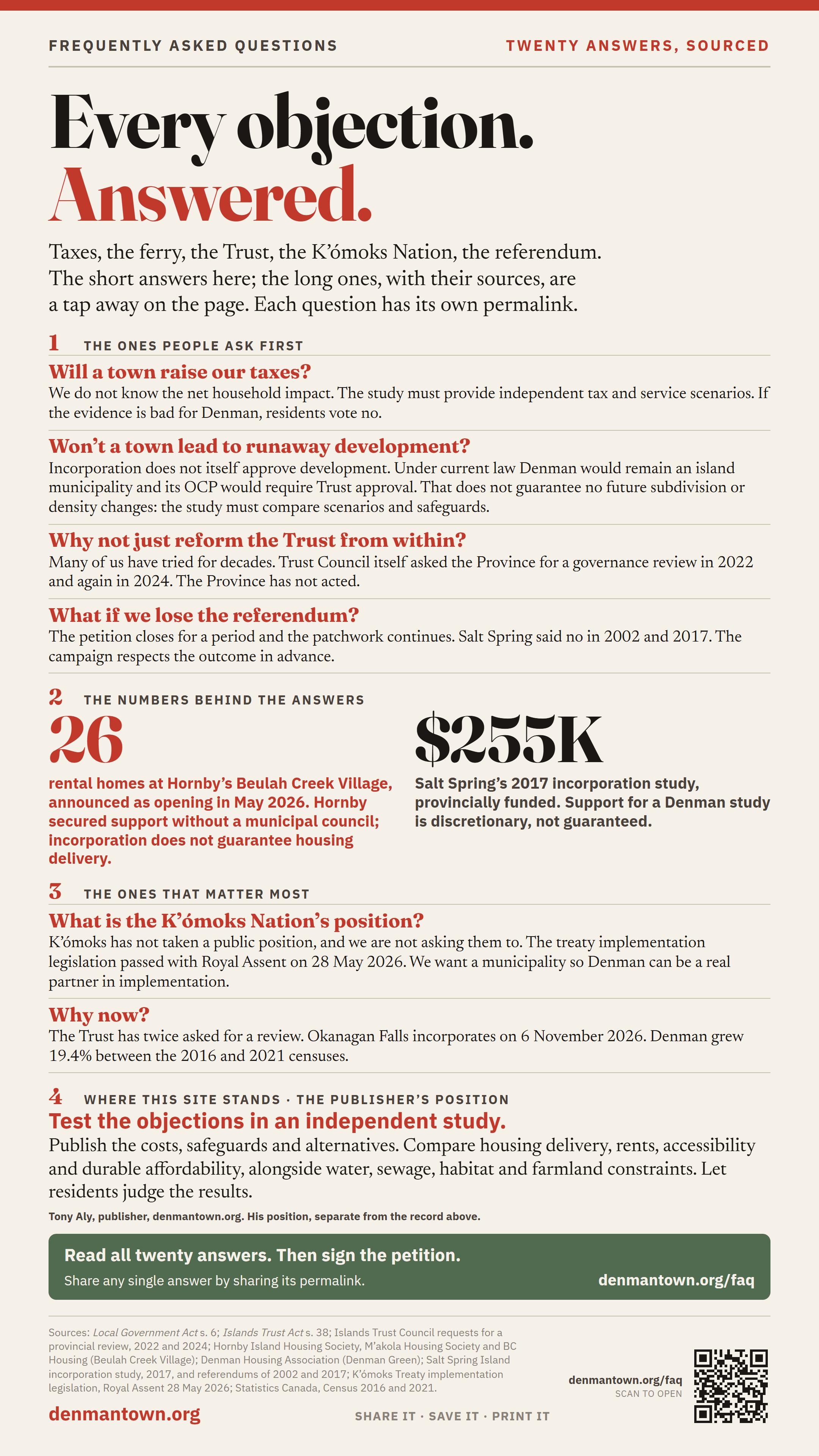
EVERY OBJECTION ANSWERED
Frequently asked questions.
Tap any question to expand the answer. Each question has its own permalink — share an answer by sharing its URL.
Will incorporation raise our taxes?
The honest answer is: we don’t know yet, and that is what the Restructure Study is designed to tell us. A formal Denman study would need independently prepared, constant-dollar tax and service scenarios specific to our circumstances, including debt, grants, roads, policing, service levels, and transferred obligations. Provincial support may be available, but it is discretionary and subject to the Province’s circumstances and budget. We need to see the numbers before deciding. If the study shows incorporation is fiscally bad for Denman, we vote no.
Will roads still be a mess?
In the short term, yes. Roads on Denman are owned and maintained by the BC Ministry of Transportation and Infrastructure, and they remain provincial property after incorporation. A municipality cannot unilaterally take over road ownership; that would require a transfer agreement with the Province, which is rare and slow. What changes is the conversation. Cumberland — population 4,500, twenty-five minutes away — has a public works department, a council that votes on the road budget, and a five-year capital plan that residents can read, comment on, and oppose. When a Cumberland road fails, a councillor’s phone rings. A Denman council can choose to negotiate a service agreement with MOTI, hire its own contractors for maintenance through CVRD agreements, or apply for federal and provincial road-infrastructure grants that are restricted to local governments. None of these paths are easy. All of them are unavailable to us today.
What about the cable ferry?
A municipal council would not magically replace the Baynes Sound Connector. BC Ferries is a private company operating as an independently regulated provincial ferry-service contractor. Its operational decisions are made by its board and management—not by any local government, including Bowen’s. What changes is who BC Ferries answers to when something goes wrong. Right now, BC Ferries deals with a non-binding Ferry Advisory Committee that meets, asks questions, and is ignored. With a municipality, BC Ferries would deal with an elected council that has staff, a budget, and the standing to litigate if necessary. BC Ferries still makes the operational decisions. But the conversation about route reliability, scheduling, and capital investment becomes one between two governments instead of between BC Ferries and a volunteer advisory body. That is not a guarantee. It is a seat at the table we currently do not have.
Will the town fix the power outages?
Honestly: not directly. BC Hydro is a Crown corporation, and a Denman town council has no authority to take over its operations. The power lines stay where they are. The trees stay where they are. Most of those above-ground lines through dense second-growth forest will keep falling over in winter storms.
What changes is what we can do about it. A municipal council can negotiate line-burial priority for critical corridors with BC Hydro under a formal protocol — something the Trust and the regional district both lack the standing to do. It can apply for federal and provincial infrastructure resilience grants that are restricted to local governments. It can fund battery-backup and microgrid systems at community anchor points: the fire hall, the school, the clinic, the community halls — so that when the lines do go down, the island has working facilities for warming, charging, and coordination. It can coordinate vegetation management proactively rather than after the next storm. And it can hold BC Hydro to restoration-time commitments that a regional electoral area cannot meaningfully demand.
A town doesn’t run BC Hydro. It stops being invisible to BC Hydro.
What about water? Will my well be safer?
Provincial mapping shows Aquifer 740 beneath nearly the entire island, classified High vulnerability, Low productivity, and Moderate demand. A smaller confined sand-and-gravel aquifer, Aquifer 739, lies along part of the east side. Most residents draw from private wells. There is currently no single local body — not the Trust, not the regional district, not the Province — with an operational mandate to manage Denman’s water supply island-wide.
A town council can change three things. First, commission a current Groundwater Availability Assessment for Denman of the kind already completed for Galiano, Mayne, and the Penders — so we know how much water we have, where the recharge happens, and where saltwater intrusion is a risk. Second, develop and enforce a local water conservation strategy with teeth — including coordinating septic-to-well setbacks under modern siting standards. Third, plan for the possibility of community water systems in denser areas of the village, drawing on the Salt Spring Watershed Protection Alliance model.
Your individual well stays your individual well. But the aquifer it draws from gets, for the first time, an actual steward.
Will incorporation give us better internet and cell service?
The internet question is mostly already solved. CityWest finished underground fibre to about 95 percent of occupied properties on Denman by 2023, after a four-year volunteer push by the Hornby/Denman Internet Committee. TELUS, the prior provider, told the committee the island was a low priority and would not be upgraded. The Province eventually committed $5.64 million in Connecting BC funds to the project, which built out at a cost to local taxpayers of roughly $33 per year on a $600,000 property.
Three things are still unfinished. The last 5 percent of properties don’t have fibre yet — mostly the more remote roads. Cell service across the island remains genuinely poor, with the volunteer fire department itself telling residents not to bother texting. And there is no funded plan for emergency communications redundancy.
A municipality can’t regulate telecom directly — that is federal CRTC jurisdiction. But it can negotiate franchise terms with carriers, apply for cell-coverage grants restricted to local governments, build emergency communications infrastructure, and — based on the CityWest experience — a municipality could plausibly compress a four-year volunteer campaign into a fraction of that time.
The deeper lesson from CityWest is that Denman can organize and can win. We just shouldn’t have to do it on volunteer time, in our spare hours, against multi-year timelines, every time.
What about the trash and recycling? Will I lose the Free Store?
The current system reflects Denman at its best and at its most-overworked. The best part: a community that organized itself, decades ago, to do its own recycling at a depot run by DIRA’s Waste Management Committee — entirely on volunteer time. The bottle depot, the recycling sort, the beloved Free Store, the careful sorting guidelines, all of it. The most-overworked part: a household that has to drag its trash bag a kilometre or more to the nearest drivable road on a Thursday morning, having paid three dollars per bag for the sticker, while a CVRD-contracted truck does the actual hauling.
A municipality changes this. Bowen Island, for example, has universal curbside garbage and recycling pickup. Most small BC towns do. Denman could too — and could add a green bin for organics that would meaningfully reduce both landfill volume and summer fire-fuel load. The sticker tax disappears, replaced by a property-tax-funded service, at a comparable cost in most small BC towns. Hazardous waste collection days, construction waste services, and proper electronics handling all become possible when there’s a body that can sign service contracts and apply for solid-waste infrastructure grants.
The Free Store does not close. The depot does not close. Both can become funded community amenities with paid staff, longer hours, and dedicated infrastructure — which is what they would already be in any other small town. The volunteers who have carried this work for decades get to be volunteers because they want to, not because no one else will.
How will incorporation actually help with the housing crisis?
Incorporation might improve coordination, but it does not guarantee housing funding or completed homes. Hornby is an important comparison: it secured funding for Beulah Creek Village without incorporating. BC Housing’s May 2026 announcement describes 26 rental homes, owned and operated by M’akola Housing Society on land leased from Hornby Island Housing Society, with federal, provincial and CVRD contributions. That demonstrates a non-municipal route to funded affordable housing; it does not isolate the reason Denman Green has taken longer.
The study should compare what a council could add with what existing bodies and housing societies can already do: permit suitable infill, coordinate servicing, support an experienced housing operator, and assemble land and financing. It should identify each grant program, eligible applicants, operating commitments and affordability terms. BC Housing’s Community Housing Fund framework includes eligible non-profit societies and housing co-ops as well as municipal housing providers. Municipal status is not a general prerequisite for housing assistance.
Our test is delivery: how many year-round homes, for which households, at what rents or purchase costs, with what protection for affordability over time? More zoning capacity is useful only as one part of that assessment. A new council still needs workable sites, approvals, financing and partners.
Won't a town just lead to runaway development and ruin Denman?
Incorporation does not itself approve development. It also cannot guarantee that future development policy will stay unchanged.
A Denman municipality, like Bowen Island Municipality before it, would remain inside the Islands Trust area. That is not optional — it is required by section 6 of the BC Local Government Act. The Trust’s “preserve and protect” mandate continues to apply. Section 38 of the Islands Trust Act requires that any municipal Official Community Plan within the Trust area must be approved by the Trust Executive Committee. In practical terms, that means the highest-level rules governing what gets built where — density caps, the rural-residential character of most of the island, the relationship between built area and protected area — remain under Trust review and approval. A town council would exercise municipal planning powers within that framework and other applicable law. OCP approval is not a promise that no subdivision or density change could ever be approved.
What a council can do is the boring, granular, day-to-day work of housing the existing community: secondary suites, ADUs, BC Housing partnerships, ALR farm worker housing, density bonusing in suitable locations, and integrated infrastructure planning. Each proposal still needs a lawful approval path and a viable delivery plan. Some would require amendments to existing density rules. Neither municipal status nor a planning designation guarantees that a home will be affordable to a local worker, family or senior.
A study should compare plausible development and housing scenarios, including the status quo, instead of promising either no change or automatic progress on Denman Green. Residents should see the environmental safeguards, costs, funding dependencies and expected housing outcomes before deciding.
What about the oyster leases?
Baynes Sound, the strait between Denman and Vancouver Island, produces 39 percent of the farmed oysters and 55 percent of the manila clams in British Columbia. By any measure, this is the shellfish capital of the province. It is also the most consequential thing happening in our local environment, and the body that regulates it — Fisheries and Oceans Canada — is in Ottawa.
A town council cannot take over DFO’s role; aquaculture is federal jurisdiction and would remain so after incorporation. But it can do four things that are not currently possible. First, file complaints with the standing of a local government, which DFO answers differently than letters from volunteer associations. Second, advocate separately to DFO on operating licences and to the Province on Crown-land tenure renewals, with the standing of a local government. Third, negotiate cost-sharing agreements with the BC Shellfish Growers’ Association directly, leveraging local-government authority rather than asking nicely. Fourth, develop a coordinated foreshore management strategy with DFO, BC Parks, the Islands Trust Conservancy, the DCA, and ADIMS — the kind of integrated coastal management that no body on Denman currently has the capacity to attempt.
The work that ADIMS volunteers have been doing for fifteen years would not stop. It would, for the first time, have a partner with statutory standing.
What happens to DIRA, DICES, DIRCS, Denman Community Housing, and the Conservancy?
A common worry — especially about the Denman Conservancy Association, which has been doing extraordinary work for thirty-five years and stewards close to nine percent of the island.
The honest answer is that nothing forces any of these organizations to change. They are non-profit societies. The DCA is a registered land trust with its own board, its own membership, its own funding, its own covenants, and its own legal title to dozens of properties. None of that changes with incorporation. The same is true of DIRA, DICES, DIRCS, the Marine Stewards, the volunteer fire department, Denman Community Housing Society, and DenmanWORKS!.
What does change is that some functions currently delivered by these volunteer groups could, if the community chose, be absorbed into the municipality, while others would carry on exactly as they do today. Bowen’s experience has been mixed. Some non-profits became municipal departments (recreation, parks, community facilities). Some merged. Some kept doing exactly what they were doing alongside the new council. None were forcibly dissolved.
For the DCA specifically: incorporation gives the Conservancy a partner — an elected council that can fund acquisitions, coordinate covenants, and participate in joint stewardship. It does not give the council authority over DCA’s lands. The Conservancy continues to be the Conservancy. It just stops being one of the only voices in the room.
The Denman Housing Association and Denman Community Land Trust Association merged in August 2024 to form Denman Community Housing Society. A study should ask this existing organization and other service providers what municipal support, if any, would help them. It should not assume a new council is the partner they need or promise to change their operations.
Will we lose the Islands Trust's preserve-and-protect protections?
Under current law, municipal incorporation alone would not remove Denman from the Islands Trust. The Bowen model keeps Denman within the Trust because the Local Government Act requires it. Section 6 of the Act states that any new municipality inside the trust area is automatically classified as an island municipality and remains subject to the Trust’s land-use oversight. Our Official Community Plan would still go to the Trust Executive Committee for approval under section 38 of the Islands Trust Act. The “preserve and protect” mandate would still apply to all our land-use decisions for as long as the Trust area exists. What changes is that day-to-day decisions — bylaws, permits, enforcement, planning, services — are made by an elected Denman council answerable to Denman residents, instead of by a three-person committee that includes an off-island chair appointed by the Trust. Abolishing or redrawing the Trust is a separate provincial decision; this petition neither requires nor forbids it.
Why not just leave the Islands Trust altogether?
We thought hard about this. Under section 6 of the BC Local Government Act, any community inside the Islands Trust area that incorporates must be incorporated as an “island municipality” — there is no exception. The only way to incorporate as a regular municipality outside the Trust would be for the BC Legislature to first amend the Islands Trust Act and redraw the trust area boundary to remove Denman from it, or repeal the Trust framework. The Legislature can do either. This petition asks for the municipal study that current law permits today. That is the Bowen path: incorporate as an island municipality, run our own local affairs, and reduce the Trust’s role in our lives from “running our local government” to “approving our Official Community Plan and running the regional Conservancy.” Our annual tax contribution to the Trust would drop substantially. Our two municipal trustees on Trust Council would be members of our own elected council, doing it ex officio under section 7 of the Trust Act — not extra people. Whether Denman also supports abolition is a separate question at abolishislandstrust.org.
Why not just reform the Islands Trust from within?
Reform remains a legitimate position. Trust Council formally requested a provincial governance review in 2022 and again in 2024, but the Province has not yet completed one. A Restructure Study would not stop that work: it would give Denman a separate, evidence-based comparison of municipal costs, powers, and accountability. Residents could then assess reform, incorporation, and the status quo on a public record.
What's the K'ómoks Nation's position, and how does the treaty affect this?
The K’ómoks Nation has not, at the time of writing, taken a public position on Denman’s incorporation as such. We have not asked them to take one and we are not asking them to take one. The conversation we are seeking is one of partnership, not endorsement.
What is true and important is that the K’ómoks Treaty has been ratified by Nation members and the implementation legislation was tabled in the BC Legislature on April 14, 2026, and passed with Royal Assent on May 28, 2026. Federal ratification and other implementation steps remain. If those steps are completed, the currently anticipated effective treaty date is in 2028. The treaty creates specific institutions and collaborative or shared decision-making processes. Their scope must be described from the treaty itself, not generalized as blanket co-decision authority.
K’ómoks has not endorsed this campaign. If the Province commissions a Restructure Study, the process must respect the Nation’s rights, treaty implementation, and chosen forms of engagement. The campaign cannot promise consultation on the Province’s behalf or use the treaty as proof that incorporation is required.
Why now?
Three reasons. First, the Islands Trust itself has formally requested a provincial governance review twice (2022, 2024), and the Province has not acted. The Trust knows the system is broken; we should act on that knowledge while the door is open. Second, Okanagan Falls approved incorporation in a March 2025 referendum. Its first election is set for October 17, 2026, and formal incorporation for November 6, 2026. That gives the Ministry recent restructure-process experience. Third, Denman has grown nearly 20 percent in five years — roughly two and a half times the BC average of 7.6 percent. The longer we wait, the harder this becomes: housing scarcity worsens, aging infrastructure decays, volunteer capacity erodes, and demographic pressures compound. The window is now.
How long will this take?
No Denman timeline can be promised. The Province first decides whether to support and fund a study; public work, a referendum, and any incorporation steps would follow only if earlier stages proceed. Bowen’s process took roughly four years from study commission (1996) to first incorporation date (1999) to first council election. Okanagan Falls is moving faster — residents voted in March 2025, the Province issued the Letters Patent in 2026, and the District of Okanagan Falls comes into being on November 6, 2026, with its first municipal election on October 17, 2026. Those precedents illustrate possibilities, not a guaranteed Denman schedule.
What if we lose the referendum?
Then the petition closes for a period, the patchwork continues, and the campaign accepts the result. Salt Spring rejected incorporation in 2002 and again in 2017, and the island has continued operating under the existing Trust-and-regional-district arrangement since. A no-vote on Denman would not foreclose future efforts — Salt Spring continues to debate its governance model — but it would settle the matter for at least a generation of residents. The campaign respects that outcome in advance. The point of the Restructure Study is to give every Denman resident the information they need to make this decision honestly.
Does the campaign founder have a personal land-use interest on Denman?
Yes. Tony Aly is involved with Camp Denman, also known as Elkhaven / Elk Haven. He has a personal interest in land-use and bylaw-enforcement matters affecting that site, and that relationship is disclosed on the ownership and transparency page. He has nothing to hide about it.
How much will the study cost? Who pays?
The Salt Spring Island Restructure Study in 2017 cost approximately $255,000 and received provincial funding. BC’s restructure grants state that study funding may be available depending on the circumstances and provincial budget. Denman would request provincial support and independent preparation, but neither the amount nor full funding is guaranteed. Funding terms must be known and disclosed before the community commits to a process.