HOW WE GOT HERE
Fifty-two years of the Islands Trust. A century-and-a-half of Denman.
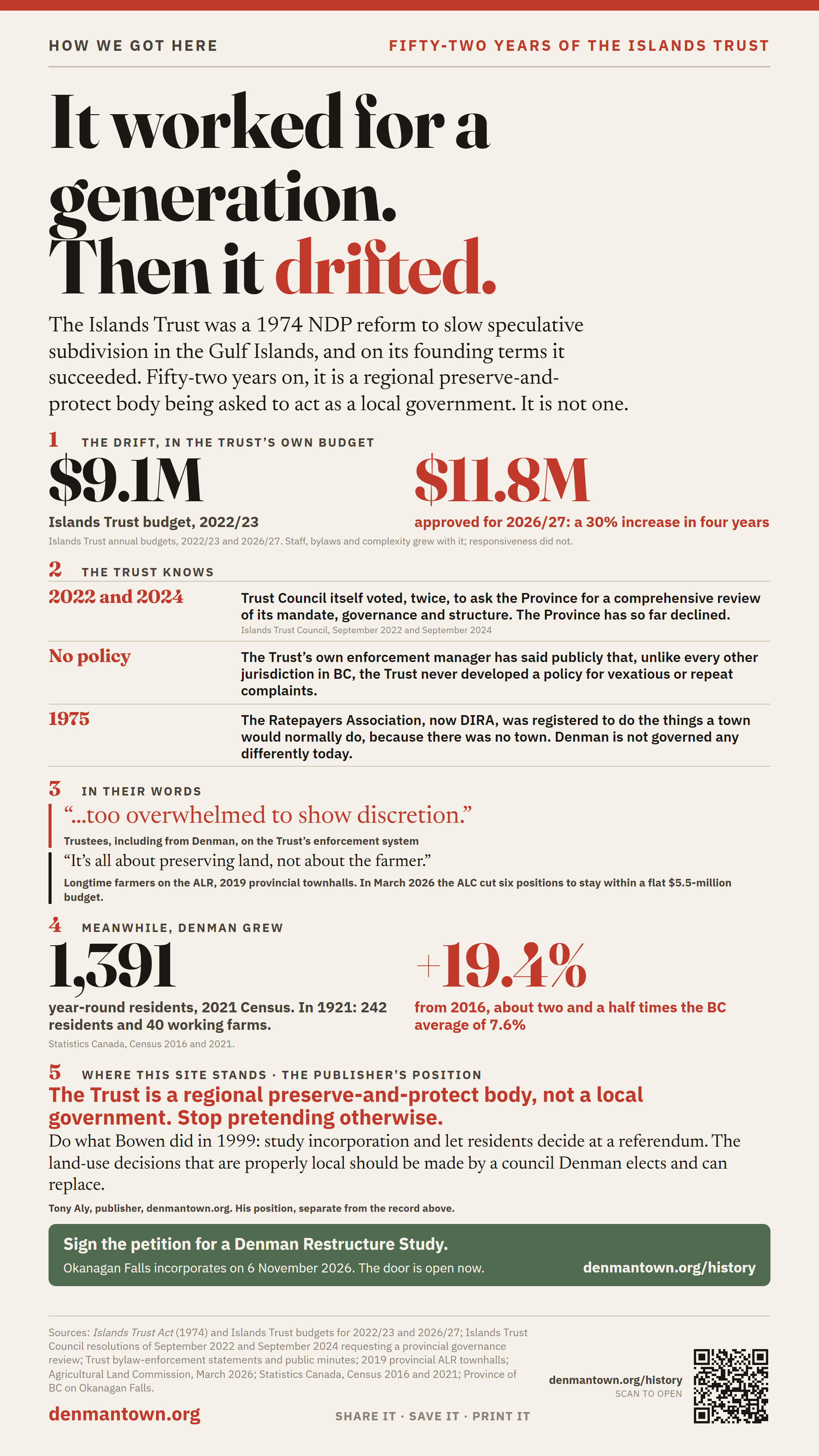
To understand why we’re asking for a town now, you have to understand what the Islands Trust was meant to be, and where it drifted.
Denman, briefly
Denman Island was Pentlatch territory long before it was anyone’s idea of a place to govern. A 1862 smallpox epidemic devastated the population; the survivors moved north to join the K’ómoks. European settlers arrived in the 1870s, drawn by coal at the Tsable River across Baynes Sound and the small farms that began to take root on the island’s gentle east-facing land.
By 1921 there were 242 residents and 40 working farms. The community built a one-room school in 1878, a hall, churches, a Legion. The Denman Island Ratepayers Association — now DIRA — was registered as a non-profit in 1975 to do the things a town would normally do, because there was no town to do them.
The 1960s and 1970s brought a back-to-the-land migration. Today’s island culture — its conservancy ethic, its volunteerism, its Spinners and Weavers and Seed Savers, its monthly Flagstone — was largely built by that wave. The 2021 Census recorded 1,391 year-round residents, a 19.4 percent increase from 2016.
We are not the small island we used to be. We are not, however, governed any differently than we were in 1975.
The Trust we joined
In 1974, the BC government of Dave Barrett — the same NDP government that had passed the Agricultural Land Reserve a year earlier — created the Islands Trust to slow speculative subdivision in the Gulf Islands. The mandate, written into the Islands Trust Act, was to “preserve and protect” the islands and their unique amenities and environment.
For its first generation, the Trust did exactly that. Subdivision pressures eased. Sensitive ecosystems were mapped. A Conservancy was created by a 1989 amendment and established in 1990. The Trust was, on its founding terms, a success.
But the institution has drifted. The Trust’s budget has grown from $9.1 million in 2022/23 to $11.8 million approved for 2026/27 — a 30 percent increase in four years. In September 2022, and again in September 2024, the Islands Trust Council itself voted to formally request that the Province of British Columbia conduct a comprehensive review of its mandate, governance, and structure. The Province has so far declined.
The Trust’s own enforcement manager has publicly stated that, unlike every other jurisdiction in BC, the Islands Trust never developed a policy to deal with vexatious or repeat complaints. Trustees, including from Denman, have called the system “too overwhelmed to show discretion.”
This project asks Denman to do what Bowen did in 1999: study municipal incorporation and let residents decide at referendum. Current law would put that municipality inside the Trust while the Trust area exists. That is a constraint, not a promise to keep the Trust; abolition is a separate decision for the Province.
The ALR around us
A great deal of Denman is in the Agricultural Land Reserve, established by the same Barrett government in 1973 and administered by the Agricultural Land Commission. The ALR has been one of the most consequential pieces of land-use legislation in Canadian history — it has likely saved the Fraser Valley from becoming Los Angeles.
But the ALR has also drifted into a posture that protects land more than it enables farming. As longtime farmers in the 2019 provincial townhalls put it: “It’s all about preserving land, not about the farmer.” In March 2026, the ALC announced it was cutting six positions to stay within a flat $5.5-million budget — a sign that the institution itself is under strain.
A Denman municipal council would still operate inside the ALR. Agritourism would still be a recognized lawful use under the ALR Use Regulation. None of that changes. What changes is that decisions about how Denman uses its agricultural land — within ALR rules — would be made by Denman’s elected council, not by trustees and a chair who do not live here.
This is not a fight against the ALR. It is a request to bring local democratic decision-making to bear on the parts of land use that are, properly, local.
The drift
The Trust was, on its founding terms, a success — for the first generation. Subdivision pressures eased on the Gulf Islands at exactly the moment they were intensifying everywhere else in BC. Sensitive ecosystems got mapped. Conservation covenants got registered. The Conservancy, created by a 1989 amendment and established in 1990 as the Trust’s own land-trust arm, has grown into one of the most respected coastal conservancy bodies in Canada. None of this is being argued against.
What has happened since is institutional drift. The Trust’s annual budget has grown from $9.1 million in 2022/23 to $11.8 million approved for 2026/27 — a 30 percent increase in four years. The number of staff has grown. The number of bylaws has grown. The complexity of the planning and enforcement system has grown. What has not grown — what has, in many ways, shrunk — is the institution’s responsiveness to the communities it governs.
The Trust Council itself has now twice formally requested that the Province conduct a comprehensive review of its mandate and structure (September 2022 and September 2024). The Province has so far not acted. The Trust’s own staff, in public minutes, have admitted that the enforcement system has no policy for managing vexatious or repeat complaints. The Trust’s own trustees, including from Denman, have publicly described the system as “too overwhelmed to show discretion.”
The argument is not that the Trust is bad. The argument is that the Trust is a regional preserve-and-protect body, not a local government, and we need to stop pretending otherwise.
Why now
First, the Islands Trust itself has formally requested a provincial governance review twice (2022, 2024), and the Province has not acted. The Trust knows the system is broken; we should act on that knowledge while the door is open.
Second, Okanagan Falls approved incorporation by referendum in 2025 and is scheduled to incorporate formally on November 6, 2026. The Province’s Ministry of Housing and Municipal Affairs has fresh process, fresh staff, and fresh appetite for restructure work. The administrative pathway from petition to study to referendum to Letters Patent has been walked recently and walked successfully — by a smaller community than Denman.
Third, Denman has grown nearly 20 percent in five years — roughly two and a half times the BC provincial average of 7.6 percent over the same period. The longer we wait, the harder this becomes. Housing scarcity worsens. Aging infrastructure decays. Volunteer capacity erodes. Demographic pressures compound. The window for orderly, locally-led incorporation is now.
Acknowledgement
The land we live on has been Pentlatch and K’ómoks territory since time immemorial. The work of incorporation will, if it proceeds, take place in genuine consultation with the K’ómoks First Nation.
This is more than a formality in 2026. The K’ómoks Treaty was ratified by Nation members in March 2025 and the implementation legislation was tabled in the BC Legislature on April 14, 2026, and passed with Royal Assent on May 28, 2026. Federal ratification and other implementation steps remain. The treaty creates specific institutions and collaborative or shared decision-making processes. Their scope must be described from the treaty itself, not generalized as blanket co-decision authority.
K’ómoks has not endorsed this campaign. If the Province commissions a Restructure Study, the process must respect the Nation’s rights, treaty implementation, and chosen forms of engagement. A municipal government would not entitle this campaign to speak for the Nation.
This site is published with that obligation in mind.