WHY DENMAN NEEDS A TOWN
Fragmented authority. No Denman municipal council.
A walk through statutory governments and regulators, CVRD services, Crown or contracted providers, and community nonprofits. They are not fourteen governments; they are different parts of a fragmented system.
Elected governments and statutory regulators
Islands Trust — Denman Local Trust Committee (ITRUST)
- What it does
- Administers local land-use planning: zoning bylaws, permits and enforcement. Funded by an Islands Trust property-tax requisition.
- Who elects or appoints it
- Two Denman-elected trustees, plus an Executive Committee member appointed by the Trust Council chair.
- Who it answers to
- The Local Trust Committee within the Islands Trust's special-purpose local-government structure.
Partially elected · Land-use planning.
Comox Valley Regional District, Electoral Area A (CVRD)
- What it does
- Provides regional and Denman local services including solid waste, streetlighting, recreation, fire-protection funding, parks, garbage collection, economic development, heritage conservation and feasibility studies.
- Who elects or appoints it
- One elected director represents roughly 7,900 people across Denman, Hornby and Baynes Sound on a ten-member board.
- Who it answers to
- The elected CVRD Board, headquartered in Courtenay.
One director for three communities.
BC Ministry of Transportation and Infrastructure (MOTI)
- What it does
- Owns and maintains public roads on Denman through a regional provincial system. There is no on-island public-works department or Denman council setting a local road budget.
- Who elects or appoints it
- Denman voters elect an MLA in a larger riding; the responsible minister serves in the provincial government.
- Who it answers to
- The BC Legislature and provincial government.
Provincial roads · No island public-works department.
Royal Canadian Mounted Police, Comox Valley Detachment
- What it does
- No detachment on Denman. Non-emergency and emergency response comes through the off-island detachment and 911 system.
- Who elects or appoints it
- Federal RCMP command under BC's provincial policing agreement and ministerial accountability.
- Who it answers to
- RCMP E Division, the provincial policing framework and the federal government.
No on-island detachment.
Fisheries and Oceans Canada (DFO / MPO) and the Province of BC
- What it does
- DFO regulates and licenses aquaculture operations. The Province separately issues and manages Crown-land tenures for aquaculture sites. Neither role belongs to a Denman local body.
- Who elects or appoints it
- Federal and provincial ministers and their departments.
- Who it answers to
- DFO is accountable through Parliament; provincial Crown-land tenure decisions are accountable through the BC government.
Federal licence · Provincial tenure.
Baynes Sound — the strait between Denman and Vancouver Island — is a major shellfish-production area. Accurately separating operational licensing from Crown-land tenure matters because local advocacy may need to address both governments.
CVRD and local service delivery
CVRD Graham Lake Water Local Service Area
- What it does
- The current CVRD water service serves approximately 91 properties and about 200 residents. The former Graham Lake Improvement District was converted to a CVRD local service area on January 1, 2023.
- Who elects or appoints it
- The elected CVRD Board, with Electoral Area A representation.
- Who it answers to
- The CVRD under its Graham Lake Water Local Service Area bylaw.
CVRD service · About 91 properties.
Denman Island Volunteer Fire Department (DIVFD)
- What it does
- Twenty-four volunteer firefighters and seven auxiliary. Funded through a CVRD service area. Coordinates with the BC Wildfire Service for fire-danger ratings and seasonal bans. The closest paid fire response is on Vancouver Island.
- Who elects or appoints it
- The Fire Chief and officers are appointed by the Society's board.
- Who it answers to
- Their board, the CVRD service-area governance, and operationally to the Fire Chief.
Volunteer · CVRD-funded.
Crown or contracted service providers
BC Ferries — British Columbia Ferry Services Inc.
- What it does
- Operates our only connection to Vancouver Island via the cable ferry MV Baynes Sound Connector. We have a non-binding Ferry Advisory Committee. BC Ferries is a private company operating as an independently regulated provincial ferry-service contractor, not a Crown corporation.
- Who elects or appoints it
- Its board and management operate under the Coastal Ferry Act and BC Ferries Commissioner oversight.
- Who it answers to
- The BC Ferry Authority appoints the BC Ferries board; the Province contracts for service and the independent commissioner regulates defined matters.
Independent contractor · Advisory only.
Community nonprofit organizations
Denman Island Residents Association (DIRA)
- What it does
- Founded 1975 as the Ratepayers Association. Volunteer non-profit. Receives and disburses CVRD recreation grants through eleven standing committees, including the Waste Management Committee that operates the recycling depot.
- Who elects or appoints it
- DIRA's board is elected by its members. Membership is free.
- Who it answers to
- Their members. DIRA has no statutory authority.
Volunteer non-profit · No statutory authority.
Denman Island Community Education Society (DICES)
- What it does
- Volunteer non-profit. Runs the food bank, Christmas Hampers, hot lunches, public laundry, parent-and-tot programs, after-school programs, the community internet site (CAP), the Farm to Family elder meal program, and is currently building the covered recreation space.
- Who elects or appoints it
- Their members.
- Who it answers to
- Their members. DICES has no statutory authority.
Volunteer non-profit · No statutory authority.
Denman Island Recreation and Community Society (DIRCS)
- What it does
- Volunteer non-profit. Operates the Community Hall, playground, and sports field.
- Who elects or appoints it
- Their members.
- Who it answers to
- Their members. DIRCS has no statutory authority.
Volunteer non-profit · No statutory authority.
DenmanWORKS! — Denman Economic Enhancement Society
- What it does
- Volunteer non-profit. Administers Community Project grants from the CVRD. Provides a Financial Support Facilitator role originally created during COVID. Has supported affordable housing fundraising and other economic-development work on Denman.
- Who elects or appoints it
- Their members.
- Who it answers to
- Their members. DenmanWORKS! has no statutory authority.
Volunteer non-profit · No statutory authority.
Denman Conservancy Association (DCA)
- What it does
- Owns or manages roughly 236 hectares of conservation land and holds conservation covenants over a further roughly 207 hectares (thirteen covenants) — together about 8.5 percent of the island. Volunteer-run, founded in 1991, ~200 members.
- Who elects or appoints it
- DCA's board is elected by its dues-paying members at its Annual General Meeting. Anyone over 16 who lives on Denman or owns property there can become a voting member.
- Who it answers to
- Their members. The DCA is a registered BC non-profit society.
Volunteer non-profit · ~8.5% of the island.
The DCA does excellent work and is broadly admired on Denman. Adding it to the patchwork is not a criticism — it's an observation that one of the largest landholders on the island operates entirely outside any elected accountability to Denman residents as a whole.
Association for Denman Island Marine Stewards (ADIMS)
- What it does
- Volunteer organization that monitors marine debris, organizes cleanups, advocates on aquaculture policy and makes submissions to public authorities.
- Who elects or appoints it
- Its members.
- Who it answers to
- Its members. ADIMS is a community nonprofit, not a government or regulator.
Community nonprofit · Marine stewardship.
ADIMS works across a fragmented system. The Trust may regulate marine land use through valid zoning; the Province manages Crown-land tenures; DFO licenses aquaculture operations.
“Denman has no general-purpose municipal council elected solely to govern the island.”
What we pay for what we get
This illustration applies the listed 2024 service rates to a residential assessment of $865,000. It is not a typical household bill: actual charges depend on property class, service-area participation, parcel taxes and exemptions. The rates come from the 2024 CVRD Property Tax Insert for Electoral Area A; estimated provincial portions are labelled separately. A study should compare complete bills and services under each governance option.
| Service | Rate / $1,000 | Annual cost |
|---|---|---|
| CVRD (Area A — shared with Hornby & Baynes Sound) | ||
| Finance and Administration | $0.2765 | $239.18 |
| Emergency Programs | $0.0336 | $29.06 |
| Regional Sustainability | $0.0367 | $31.75 |
| Recreation (regional) | $0.0574 | $49.65 |
| Electoral Area Services (incl. Denman/Hornby Bylaw Enforcement) | $0.0885 | $76.55 |
| Sewage Treatment | $0.0341 | $29.50 |
| Solid Waste Management | $0.1027 | $88.84 |
| Transportation (Comox Valley Transit) | $0.1234 | $106.74 |
| Denman-specific services | ||
| Denman Fire Protection | $0.5751 | $497.46 |
| Denman Garbage Collection | $0.1559 | $134.85 |
| Denman Streetlighting | $0.2202 | $190.47 |
| Denman Parks and Greenways | $0.1468 | $126.98 |
| Denman Community Facilities | $0.1052 | $90.99 |
| Denman Economic Development | $0.0759 | $65.65 |
| Denman Recreation | $0.0208 | $17.99 |
| Denman Grant in Aid | $0.0158 | $13.66 |
| Denman Heritage Conservation | $0.0013 | $1.12 |
| Denman Feasibility Studies | $0.0046 | $3.98 |
| CVRD shared core services subtotal | $0.7529 | $651.27 |
| Denman-specific CVRD services subtotal | ~$1,143 | |
| Plus: Islands Trust property-tax surcharge (estimate) | ~$0.25 | ~$216.25 |
| Plus: Provincial school tax, hospital, police, etc. | varies | ~$2,500–3,500 |
| Estimated total annual property tax | ~$4,600–5,600 | |
Source: 2024 CVRD Property Tax Insert, Electoral Area A. Provincial portions are estimates based on standard rates. Properties classified as farm or in the ALR may pay considerably less. Properties in the Graham Lake Water Local Service Area also pay parcel taxes.
What you’ll notice.
The schedule lists separate services, including streetlighting, economic development, heritage conservation and bylaw enforcement. A tax-rate list alone does not establish who receives each service, whether it is adequate, or whether a municipality would deliver it more effectively. Those questions need service boundaries, budgets and outcomes alongside the rates.
We pay real money through several separate budgets, but there is no single Denman municipal budget where residents can see and debate the complete local-government tradeoff.
Total Area A requisition for 2024: $1,405,673 across the listed Electoral Area A services. This is an Area A figure, not Denman-only revenue or money automatically available to a future council.
“Publish the complete tax-and-service comparison before residents decide.”
The cable ferry
A CASE STUDY IN POWERLESSNESS.
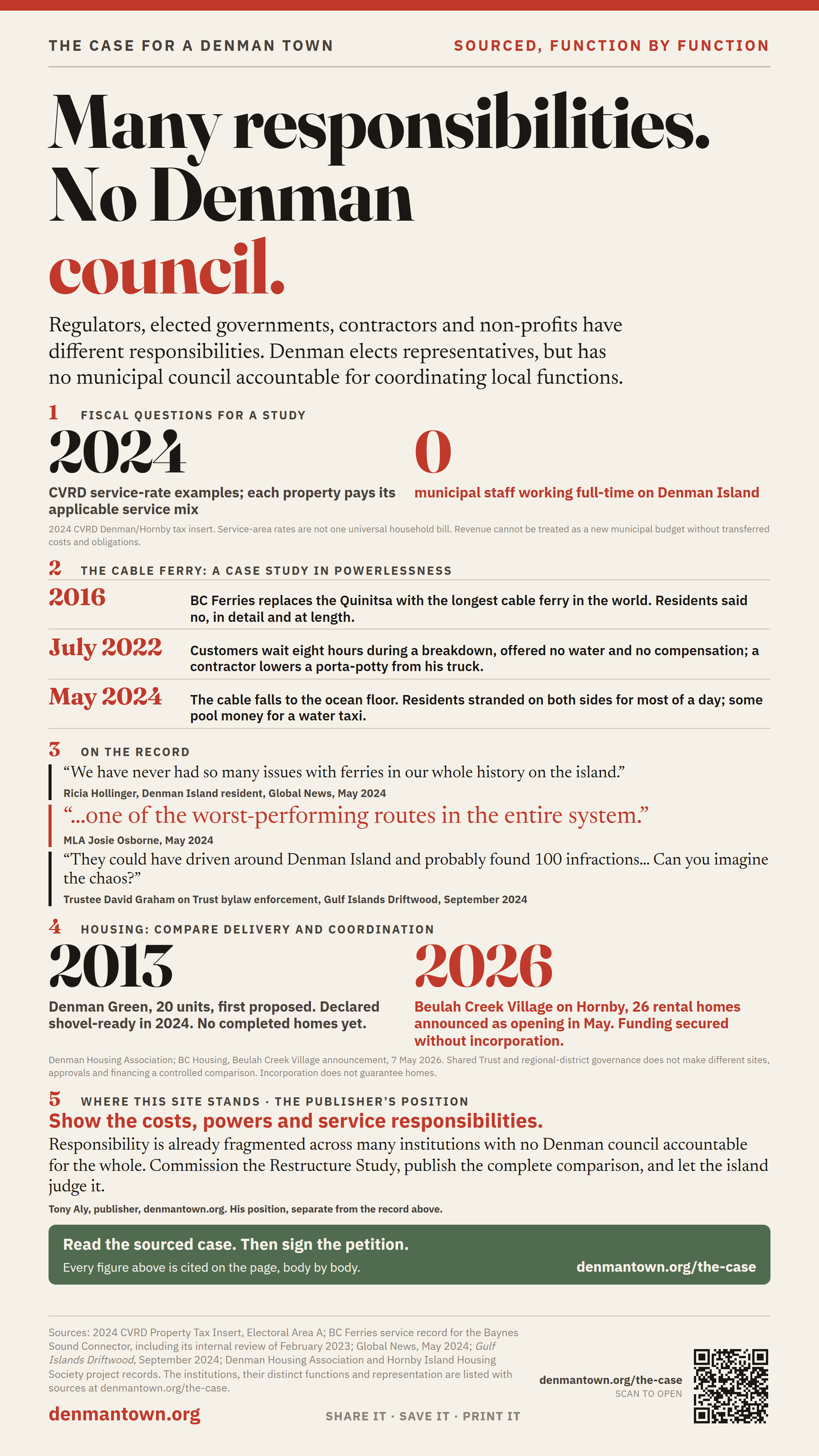
In 2016, BC Ferries replaced the conventional MV Quinitsa with the MV Baynes Sound Connector — at the time, the longest cable ferry in the world. Denman residents told them, in detail and at length, that we did not want a cable ferry. The Quinitsa had served the route since 1977 as a conventional ferry. The Baynes Sound Connector uses a three-cable system with two machinery spaces. Its service interruptions are documented below.
This is what powerlessness looks like. We told them no. They built it anyway. We told them it was breaking. They told us it wasn’t. We have a non-binding Ferry Advisory Committee that meets and asks questions. We have an MLA who has criticized the route and cannot fix it on her own. We have no municipal council consolidating Denman's evidence and advocacy as a local government.
A municipal council would not magically replace the Baynes Sound Connector. But it would put a single elected body — accountable to us, with a budget and staff — in front of BC Ferries’ management. A council would not control BC Ferries, and whether its advocacy would change service is unproven. The defensible gain is one elected body responsible for assembling the local case.
“We have never had so many issues with ferries in our whole history on the island.”— Ricia Hollinger, Denman Island resident, Global News, May 2024.
The roads, the bylaws, the no-recourse
The roads.
Denman roads are owned and maintained by the BC Ministry of Transportation and Infrastructure (MOTI). Most are gravel. The paved ones need maintenance. There is no on-island MOTI office or Denman public-works department. Residents advocate through provincial channels and elected representatives rather than a local road budget.
Compare this to a municipality. Cumberland — population about 4,500, a 25-minute drive from Buckley Bay — has a public works department, a council that votes on the road budget, and a five-year capital plan that residents can read, comment on, and oppose. When a Cumberland road fails, a councillor’s phone rings. When a Denman road fails, an email goes to a regional MOTI office in Nanaimo and is added to a list.
There is more, and it goes beyond roads:
- No building inspection. Denman has no building inspector. The Trust administers Siting and Use Permits, but this project has not located a published island-wide compliance rate. Permit and enforcement data should be published instead of guessed.
- No animal control. The CVRD animal control bylaw does not apply on Denman. Uncontrolled dogs harassing wildlife and livestock are a documented, recurring DIRA agenda item. The only “recourse” is the regional conservation officer, whose actual job is wildlife. DIRA passed a motion in June 2025 asking CVRD to study extending the bylaw to Denman. There is no mechanism to compel that study.
- No bylaw enforcement against most things that bother neighbours. Noise, lighting, derelict vehicles, illegal dumping, short-term rentals, fencing disputes — most of these are either unregulated or regulated by bodies with no presence on the island.
- No police on island. RCMP non-emergency calls go to Courtenay. RCMP response time depends on the ferry schedule. Hornby has a small detachment. Denman does not.
The bylaws.
Bylaw enforcement on Denman is administered through the Islands Trust. The Trust’s own public discussion has identified workload and complaint-policy problems. Trustees, including from Denman, have criticized a system they say is too overwhelmed to show discretion.
The Denman trustee David Graham, speaking to Gulf Islands Driftwood in September 2024, captured the situation as plainly as anyone has:
“They could have driven around Denman Island and probably found 100 infractions and sent that along to the bylaw enforcement, and they would’ve been swamped. Can you imagine the chaos?”
That is the attack worth making: publish openings, closures, dispositions and file age by Local Trust Area so the public can test whether the enforcement system works.
The utilities under our feet and over our heads
Most Denman households rely on private wells and individual septic systems, while the CVRD Graham Lake water service supplies approximately 91 properties and about 200 residents. Power generally arrives on a line that swings from a tree-fringed pole somewhere up the road. Most of us, until recently, also lived with the worst residential internet in the Comox Valley. We buy stickers for our trash bags and drag them — sometimes a kilometre or more — to the nearest drivable road, then drive our recycling separately to a depot we run ourselves. Some are private, some provincial, and some regional. No single island council is responsible for coordinating the whole picture.
Water.
Provincial mapping shows Aquifer 740 beneath nearly the entire island, classified High vulnerability, Low productivity, and Moderate demand. A smaller confined sand-and-gravel aquifer, Aquifer 739, lies along part of the east side. Most residents draw from private wells. A growing share have to top up with cistern deliveries each summer — and according to the Hornby and Denman Community Profile, those deliveries are starting earlier and running later each year.
Power.
BC Hydro delivers power on overhead lines through dense second-growth forest. Storms drop trees on lines. Outages happen. A municipality cannot take over BC Hydro — it is a Crown corporation. A restructure study should test whether municipal coordination would change access to resilience grants, critical-corridor planning or community backup power, and what those options would cost.
Internet.
CityWest finished underground fibre to about 95 percent of occupied properties on Denman by 2023, after a four-year volunteer push by the Hornby/Denman Internet Committee. TELUS, the prior provider, told the committee the island was a low priority and would not be upgraded. Volunteers organized; the Province eventually contributed $5.64 million; the build came in at roughly $33 per year on a $600,000 property. The lesson is that Denman can organize and can win — but shouldn’t have to do it on volunteer time, every time.
Solid waste.
DIRA volunteers run the recycling depot. Households drag their stickered trash bags to the road for a CVRD-contracted truck. Bowen Island has universal curbside garbage and recycling pickup, and a green bin for organics. A study should compare service levels, costs, labour and transfer responsibilities before promising the same here.
Sewage and septic.
Every property on Denman is on its own septic field, and oversight is provincial via Island Health. There is no local body responsible for a coordinated septic-replacement strategy as fields age. A restructure study could test whether any local coordination or grant program is lawful, useful and affordable, in cooperation with Island Health and existing provincial and Trust programs.
The treaty and Denman’s obligation to listen
The K’ómoks Treaty was ratified by Nation members in March 2025 and the implementation legislation was tabled in the BC Legislature on April 14, 2026, and passed with Royal Assent on May 28, 2026. Federal ratification and other implementation steps remain. The treaty creates specific institutions and collaborative or shared decision-making processes; their scope must be described from the treaty itself, not reduced to a blanket claim of co-decision authority.
K’ómoks has not endorsed this campaign. If the Province commissions a Restructure Study, the process must respect the Nation’s rights, treaty implementation, and chosen forms of engagement. A municipality would not create authority for this campaign to speak for the Nation.
The aquaculture under our shore
Baynes Sound, the strait between Denman and Vancouver Island, produces 39 percent of the farmed oysters and 55 percent of the manila clams in British Columbia. By any measure, this is the shellfish capital of the province. It is also the most consequential thing happening in our local environment. DFO regulates operations through its Pacific Region, while the Province manages Crown-land tenure. ADIMS volunteers have organized cleanups, monitoring, and submissions for fifteen years. A council would not gain control of either regulator. It could consolidate local evidence and advocate as a local government; whether that would change regulatory outcomes is unproven.
The housing crisis and the empty seat at the table
Denman Green is a proposed twenty-unit project at 1151 Northwest Road, including five units for seniors. Denman Community Housing Society owns the site and describes construction funding as being sought. Its predecessors, the Denman Housing Association and Denman Community Land Trust Association, merged in August 2024. These are the operator’s published accounts checked on 10 September 2026; the project page reports earlier funding applications and does not establish a current construction timetable.
Twenty kilometres north, on Hornby Island, Beulah Creek Village — 26 units, $18 million, started later — was announced as opening in May 2026. Both are on Trust islands, governed by the same Trust mandate. Both are in the same regional district. Both required Trust rezoning. Both targeted affordability through BC Housing partnerships.
Hornby proves that a municipality is not necessary. Its housing society partnered with M’akola Housing Society. BC Housing’s May 2026 announcement identifies M’akola as owner and operator of the homes, with the land leased from Hornby Island Housing Society, and records federal, provincial and CVRD funding. Shared geography and regulatory bodies do not make the two projects a controlled comparison: their sites, financing, operating arrangements and approvals need separate review.
A restructure study should test whether a Denman council would improve coordination. It must not pretend municipal status guarantees BC Housing funding, approvals or construction.
The bottom line
Denman's population does not rule a municipality out. Financial, service and transition viability are exactly what an independent restructure study must test. The patchwork already costs money and volunteer time; publish the complete comparison and let the island judge it. We are not asking for a town because we want bureaucracy. We are asking for a town because responsibility is already fragmented across many institutions, with no Denman council accountable for the whole. We are asking for a town because the people who keep Denman running cannot find a place to live on the island they keep running.