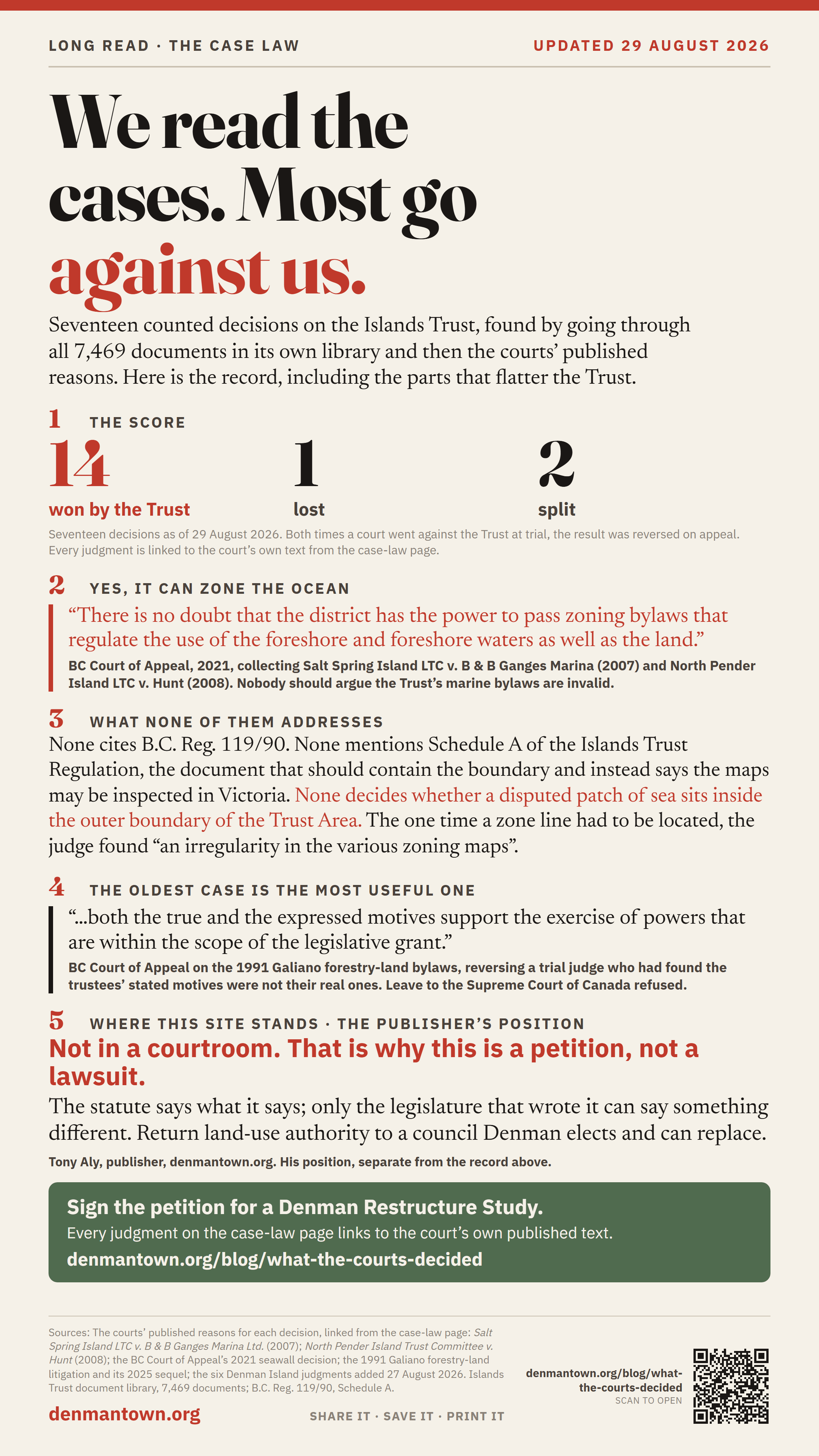
Update, 29 August 2026. The counted record is now seventeen decisions. Ellis v. Denman Island Local Trust Committee, 2020 BCSC 935 — a damages action against the committee, two trustees and an employee — had been listed here as known-to-exist and not found. It is located and read. Most of the claim was struck as an attempt to re-litigate what the 2005 trial and the appeals from it had already decided, and the rest was dismissed on summary trial. On the revised record the Trust has won fourteen, lost one and split two. The paragraph below is left as it was published.
Update, 27 August 2026. This post counted ten decisions. There are now sixteen. Searching the Trust's own document library — the method described below — found none of the six Denman Island judgments, because the Trust's library does not contain them; they were traced through a private archive and then confirmed against the courts' own published reasons. On the revised record the Trust has won thirteen, lost one and split two, and the case law page counts itself, so it was already right. The six additions are land cases: tree cutting, a coastal bluff, a development permit area, and the enforcement of a costs award. None of them disturbs the conclusion below — none cites B.C. Reg. 119/90, and none decides where the trust area ends. The original text is left as published.
This site spends a lot of its time asking the Islands Trust to publish things it would rather not publish. The water study is the sharpest example: bylaw after bylaw claims the seabed, the sea surface and the air above it, out to "the boundary of the Local Trust Area" — and that boundary lives in a map the regulation says is exempt from publication and may be inspected at an office in Victoria.
An obvious question follows, and we should have answered it before anyone had to ask. Has any of this been to court?
It has. We went through all 7,469 documents in the Trust's own library, pulled out everything that mentioned a court, and used those to find the judgments themselves — not the Trust's press releases about them, the actual published reasons. There is now a page carrying all of it.
The Trust nearly always wins
Of the ten decisions we counted, the Islands Trust won eight, lost one and split one — and both times a court went against it at first instance, the result was reversed on appeal. That is the record, and we would be publishing exactly this page if it had come out the other way, so here it is.
Eight of those we read in full from the courts' own published reasons. Two are old enough that we have them only through later judgments quoting them at length, and one we could not find at all — it is on the page anyway, marked unread, because leaving it out would flatter us: it is another Trust win.
Yes, it can zone the ocean
Our own working notes used to mark this an open question, with a warning that a hostile reader would attack there first. They would have won. A local government in British Columbia can zone the foreshore and the waters over it, and the two cases most often cited for it are both Islands Trust cases:
Salt Spring Island Local Trust Committee v. B & B Ganges Marina Ltd. (2007) concerned a two-storey floating structure used as a marina office, sitting on a water lot leased from the Province in Ganges Harbour. The Attorney General of British Columbia took part. The owners conceded the bylaw was a valid provincial-side land-use measure and argued only that federal power over navigation and shipping put their building beyond its reach. It did not. The bylaw applied, and the structure breached it.
North Pender Island Trust Committee v. Hunt (2008) concerned a shed at Port Washington that straddled the high water mark — part of it on land zoned commercial, part of it over the water in a Water Zone.
Both were upheld on appeal. In 2021 the Court of Appeal, deciding whether a Gabriola-area landowner's ancient common-law right to defend his land against the sea let him build a seawall in defiance of a setback bylaw, set out a passage collecting them: "There is no doubt that the district has the power to pass zoning bylaws that regulate the use of the foreshore and foreshore waters as well as the land". The landowner had won at trial. He lost on appeal.
So: nobody campaigning on this should argue that the Trust's marine bylaws are invalid. We have corrected our own pages accordingly.
What these decisions do not address
Here is the part that survives all of that untouched, and it is the whole point of the water study.
In the ten decisions counted in this review, the fight was about whether a bylaw reached a particular building, activity, dwelling, well, or legal interest. None cites B.C. Reg. 119/90. None mentions Schedule A of the Islands Trust Regulation, the document that is supposed to contain the boundary and instead contains a single sentence explaining that the maps may be inspected in Victoria.
None of these decisions addresses whether a disputed patch of sea sits inside the outer boundary of the Islands Trust Area. In the marine cases the parties argued federal power against provincial power; their reasons proceed on the basis that the water at issue was inside the trust area.
And in the one case where a zone line genuinely had to be located, it was proved the ordinary way — by filing the zoning maps in evidence. The judge looked at them and found "an irregularity in the various zoning maps", which he put down to "a failure to reconcile the overall coastline of the island with the particular surveys of waterfront lots".
So these decisions do not approve or reject the outer boundary. A line of cases confirming that these bylaws are valid, broadly read and enforceable over water is a reason the controlling boundary record should be easy to inspect — not a substitute for publishing it online.
The oldest case is the most useful one
In 1991 a forestry company announced it would sell its Galiano holdings. Within weeks the local trust committee passed bylaws removing all residential capability from that land. At trial the company won: the judge found the trustees' stated motives were not their real ones, that they had acted to prevent or delay the sale, and that they intended in the long run to obtain what would in effect be park land.
The Court of Appeal reversed, and it did not disturb those findings. It held they did not matter: acting for an ulterior purpose "does not lead me to conclude that the trustees exceeded their powers", because "both the true and the expressed motives support the exercise of powers that are within the scope of the legislative grant". Leave to appeal to the Supreme Court of Canada was refused. Thirty years later the same land is still zoned so that nobody may live on it, and in 2025 the Court of Appeal dismissed the latest challenge.
That is the honest shape of the thing. The object written into the Islands Trust Act — preserve and protect the trust area and its unique amenities and environment — is drawn widely enough that a court can find an ulterior purpose and uphold the bylaw in the same breath.
Which tells you where this can and cannot be settled. Not in a courtroom. The statute says what it says, and only the legislature that wrote it can say something different. That is why this is a petition and not a lawsuit.
Every judgment on the case-law page links to the court's own published text so you can read it yourself, and where we have not read something, it says so.